
France Gall
French yé-yé and pop singer, Eurovision winner, cultural icon.

via Wikipedia: France Gall · see source
France Gall (9 October 1947 – 7 January 2018) was a French yé-yé and pop singer. In 1965, at age 17, she won the tenth edition of the Eurovision Song Contest with the song "Poupée de cire, poupée de son", representing Luxembourg. Later in her career, she worked with singer-songwriter Michel Berger, whom she married in 1976. Her most successful singles include "Il jouait du piano debout", "Ella, elle l'a" and "Évidemment". Gall is regarded as one of the most beloved and acclaimed French pop singers. Her influence on French popular music, particularly through her collaborations with Michel Berger, helped shape the sound of French pop from the 1970s onward and secured her status as a cultural icon.
- born
- 9 October 1947
- died
- 7 January 2018
- field
- Singer
- nationality
- French
- known_for
- Eurovision Song Contest winner (1965); collaborations with Michel Berger; hits i
Verified Timeline
Lore & Background
France Gall was born Isabelle Geneviève Marie Anne Gall on 9 October 1947 in the 12th arrondissement of Paris, into a family of musicians. Her father, Robert Gall, was a lyricist who wrote for Édith Piaf and Charles Aznavour; her mother, singer Cécile Berthier, was the daughter of Paul Berthier, co-founder of The Little Singers of Paris. Encouraged by her father, Gall launched her career in 1963, signing with Philips Records after an audition at the Théâtre des Champs-Élysées. Her artistic director Denis Bourgeois suggested the stage name France Gall, taking inspiration from a recent rugby match between France and Wales. Her debut single "Ne sois pas si bête" premiered on her sixteenth birthday and quickly became a success. Serge Gainsbourg then wrote for her; his composition "N'écoute pas les idoles" reached the top of the charts in March 1964. In early 1965, Gall was selected to represent Luxembourg in the Eurovision Song Contest. She chose Gainsbourg's "Poupée de cire, poupée de son" from ten proposed songs. On 20 March 1965, she performed in Naples, Italy, where the song was allegedly booed in rehearsals for straying from the usual contest style. Her performance faced criticism for being out-of-tune, yet she won with 32 points, receiving top scores from Austrian, Dutch, Finnish and German juries. In 1966, Gainsbourg's "Les Sucettes" caused controversy due to double entendres alluding to oral sex; Gall, 18 at the time, said she was unaware and felt humiliated. She then entered a psychedelic era with the album 1968, featuring songs like "Teenie Weenie Boppie" about a deadly LSD trip. After a barren period in the early 1970s, Gall began collaborating with Michel Berger in 1973, struck by his song "Attends-moi". They married on 22 June 1976. Their partnership produced major hits: "Il jouait du piano debout" became her first number one in France since her Eurovision win; "Évidemment" (1987) was a homage to friend Daniel Balavoine, who died in a helicopter crash on 14 January 1986; and "Ella, elle l'a" (1987) topped charts in several countries as a tribute to Ella Fitzgerald. Gall also performed in the rock opera Starmania in 1979. Following Berger's sudden death from a heart attack on 2 August 1992, Gall completed their joint project Double jeu and performed at Bercy Arena as planned. She released her final solo album France in 1996 and retired from music in 1997.
Reader's Guide
France Gall's significance lies in her role as a defining figure of French yé-yé and pop music, particularly through her early work with Serge Gainsbourg and her later, more enduring collaboration with Michel Berger. Her 1965 Eurovision victory with "Poupée de cire, poupée de son" marked a turning point for the contest, introducing a more modern, playful style. Despite early controversies—such as the double entendres in "Les Sucettes"—Gall's career evolved from teenage pop star to a mature artist whose songs addressed personal and social themes. Her partnership with Berger produced some of the most beloved French pop songs of the late 20th century, including "Il jouait du piano debout", "Ella, elle l'a", and "Évidemment". These works not only achieved commercial success but also influenced the sound of French pop from the 1970s onward. Gall's involvement in humanitarian efforts, such as Chanteurs Sans Frontières and Action Écoles, further cemented her legacy. Her retirement in 1997 and subsequent limited public appearances only enhanced her status as a revered cultural icon in France.
Did You Know?
- Gall's stage name was inspired by a rugby match between France and Wales (French: France–Galles), suggested by her artistic director Denis Bourgeois.
- At age 18, Gall recorded 'Les Sucettes' by Serge Gainsbourg, later saying she was unaware of its double entendres about oral sex and felt humiliated.
- Her 1987 song 'Évidemment' was a homage to friend Daniel Balavoine, who died in a helicopter crash on 14 January 1986.
- The song 'Babacar' was inspired by Gall and Michel Berger's encounter with a mother in Dakar, Senegal, who asked Gall to adopt her child; they provided financial aid instead.
- In late 2024, nearly seven years after her death, the compilation album 'Plus haut' featured the previously unreleased 1974 recording 'La Prisonnière' from the unfinished musical 'Angelina Dumas'.
Musical Roots and a Parisian Debut
France Gall was born Isabelle Geneviève Marie Anne Gall in Paris's 12th arrondissement on 9 October 1947, into a household where music was practically a family language. Her father Robert Gall penned lyrics for legends like Édith Piaf and Charles Aznavour, while her mother Cécile Berthier was a singer in her own right, the daughter of Paul Berthier, co-founder of the famed Little Singers of Paris. As the only daughter between twin brothers Patrice and Philippe, young Isabelle absorbed this creative environment from childhood. She attended Lycée Paul Valéry but ultimately left school after being told she would have to repeat a year. In 1963, encouraged by her father, she auditioned at the Théâtre des Champs-Élysées and signed with Philips Records. Her artistic director Denis Bourgeois, needing to set her apart from the already-famous Isabelle Aubret, proposed the stage name France Gall — a nod to a France-versus-Wales rugby fixture. On her sixteenth birthday, her debut single "Ne sois pas si bête" hit French radio and took off. By March 1964, a Serge Gainsbourg composition, "N'écoute pas les idoles," had climbed to the top of the charts, announcing a new voice in French pop.
A Seventeen-Year-Old Conquers Eurovision
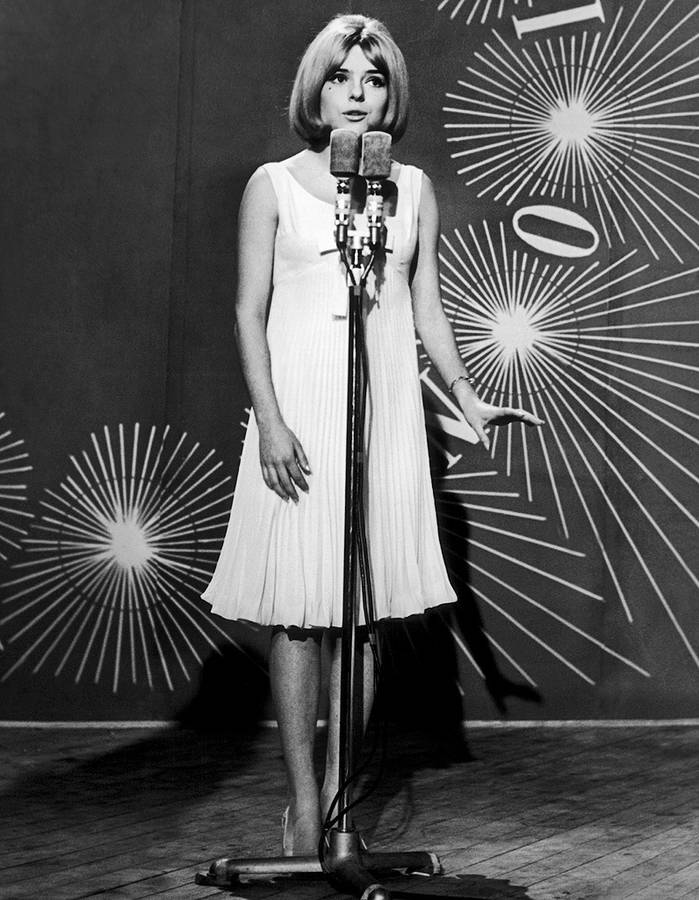
In early 1965, the Luxembourgish broadcaster CLT selected the seventeen-year-old France Gall to represent the Grand Duchy at the Eurovision Song Contest. From ten songs presented to her, she chose Gainsbourg's "Poupée de cire, poupée de son," a track that would become her defining moment. On 20 March 1965, she took the stage in Naples, Italy, to a reception that was anything but warm. Rehearsal audiences reportedly booed the number for departing so sharply from the conventional ballads typically heard at the contest. Critics who did hear the performance described it as imperfect and occasionally out of tune. Yet none of that mattered when the results came in: Gall collected 32 points, earning the top score from the Austrian, Dutch, Finnish, and German juries. The victory catapulted her beyond the French-speaking world almost overnight. She promptly recorded versions of the winning song in German, Italian, and Japanese, extending her reach into markets she had never touched. For a teenager who had been singing on French radio just two years earlier, the Naples stage had transformed her into an international name and cemented her place in the history of the contest itself.
Gainsbourg's Wild Ride and the Psychedelic Turn
The partnership between France Gall and Serge Gainsbourg proved both creatively fertile and personally turbulent. After the chart-topping "N'écoute pas les idoles" and the 1964 smash "Laisse tomber les filles," their collaboration took a provocative turn in 1966 with "Les Sucettes." On its surface the song described a girl fond of aniseed lollipops, but the wordplay carried unmistakable sexual undertones. Gall was eighteen at the time and later insisted she had no idea about the double meanings, saying the experience left her feeling humiliated and betrayed by the adults managing her career. Under Gainsbourg's direction she then plunged into a psychedelic phase, producing the 1968 album that included "Teenie Weenie Boppie," a track depicting a fatal LSD trip, and the single "Bébé requin." Simultaneously she explored the German-language market with songs like "Zwei Apfelsinen im Haar" and "Der Computer Nr. 3." By 1972, when she recorded "Frankenstein" and "Les Petits ballons" with Gainsbourg for the final time, both singles failed to chart, signaling the end of an era.
Michel Berger and a Lasting Cultural Imprint
After a difficult stretch in the early 1970s — marked by a bankrupt label, a stint at Atlantic Records that yielded no hits, and a string of underperforming singles — France Gall's career was reignited by Michel Berger. In 1973 she was struck by his song "Attends-moi," and by 1974 he was writing material specifically for her, beginning with "La Déclaration d'amour." What started as a professional arrangement quickly blossomed into a romance, and the couple married on 22 June 1976. Their creative output from that point reshaped French pop: the self-titled 1976 album, the 1977 release Dancing Disco with its hit "Si maman si," and a catalogue of beloved singles including "Il jouait du piano debout," "Ella, elle l'a," and "Évidemment." Gall's influence, particularly through the Berger partnership, helped define the sound of French popular music from the 1970s onward. She is widely regarded as one of the most beloved and acclaimed French pop singers of her generation, a cultural icon whose voice and artistry continue to resonate. She passed away on 7 January 2018, at the age of seventy.
Gallery
Frequently Asked Questions
Who is France Gall?
France Gall (1947–2018) was a French yé-yé and pop singer who became one of the most recognizable voices in French popular music. She is best remembered for her Eurovision victory at 17 and her decades-long creative partnership with Michel Berger.
What song did France Gall perform to win Eurovision?
She represented Luxembourg in 1965 with 'Poupée de cire, poupée de son,' taking the top prize at just 17 years old. That single performance put her on the international map almost overnight.
Who was Michel Berger and how did he shape France Gall's career?
Michel Berger was a singer-songwriter who married Gall in 1976 and became her principal creative collaborator. Their joint output produced many of her biggest singles and helped define French pop from the 1970s onward.
What are France Gall's most famous songs?
Beyond her Eurovision winner, her signature hits include 'Il jouait du piano debout,' 'Ella, elle l'a,' and 'Évidemment.' These tracks became radio staples and cemented her status as a defining voice of the yé-yé and post-yé-yé era.
When did France Gall die and what is her lasting legacy?
France Gall passed away on 7 January 2018, at the age of 70. She is widely regarded as a cultural icon of French pop, having bridged the yé-yé generation with the singer-songwriter era that followed.
More in Pop & Rock 1-19
Spotted an error? Know more?
This is a living reference — every entry is fact-audited, and reader corrections feed straight into our audit queue. Suggest an edit · See this site's audit record